Warren Buffett, 79 years old, is acquiring a railroad company he expects will grow with American trade in the next few decades. As the economy starts to pick up and consumption volume increases, he believes Burlington-Northern will also build up. This bet for Buffett is an investment in a "high quality, cash generating company [that has] been left in the dust during the 'junk' stock rally". The only competition he is considering are other railroads that will have a difficult time coming into the market due to the high costs of laying down a track. Some thoughts of possible competitors will be highspeed railroads or who knows, even some kind of efficient air transportation for goods 30 years from now. And looking forward, where will Buffet be? 109 years old? He seems to be thinking about the future of his company and those he's leaving in charge. Let's hope they are just as excited about this acquisition as he is.
Group 3
WSJ article
Wednesday, November 4, 2009


Companies Hoard Cash
Links:
WSJ Article: http://online.wsj.com/article/SB125712303877521763.html
Bloomberg Article: http://www.bloomberg.com/apps/news?pid=conewsstory&tkr=C%3AUS&sid=aoegJmRxtzQA
Companies are hoarding cash at levels not seen since the 1960s. According to an article titled Jittery Companies Stash Cash in the November 2nd Wall Street Journal “500 of the largest nonfinancial companies…held about $994 billion in cash, or 9.8% of their assets”. That is 2% more than last year. Now, we all remember the 3.5% growth in GDP last week, so why are companies saving cash?
Some explain this phenomenon as a “hangover” from the recession, while others claim that firms are inherently “riskier” these days. Among the 500 largest nonfinancial groups, information technology groups carry the most cash. The Wall Street Journal explains that “the 54 biggest information-technology firms held $280 billion – or 27% of their assets – in cash” citing Google as an example; “The search giant’s cash and short-term investments rose 53% to $22 billion in the third quarter from a year earlier, accounting for 58% of its total assets”
Although holding cash provides a safety net and “operating and strategic flexibility,” it begs the question of whether that cash could be put to better use in a possible future bull market. Now making market predictions could be dangerous business, but holding cash could stifle a company’s growth in a globalized market. On the other hand, holding cash could provide companies a quick source of liquidity in unsure financial times. Also, without ready access to credit, “cash can become very strategic”.
In a recent Bloomberg article, the author claimed that Citigroup and JP Morgan were “hoarding cash as if another crisis were on the way”. The article explains how Citigroup has nearly doubled its holdings in cash. Although hoarding cash may be the safe move, “it will take down the rates of returns these companies can generate” said Eric Hovde in the Bloomberg article.
This action brings into question whether banks should value rate of return over a safety net. On one hand, a safety net would ensure Citigroup’s existence and financial safety while recovering from a financial crisis. While on the other hand, investors responded to Citigroup’s diminishing rate of return through a massive sell-off on Monday. Is a bank without a decent rate of return worth investing in? Is a bank without ability to secure cash worth investing in? How much of Citigroup’s rate of return must be sacrificed for adequate financial security? We believe these questions are at the heart of Citigroup’s decision to hold more cash.
WSJ Article: http://online.wsj.com/article/SB125712303877521763.html
Bloomberg Article: http://www.bloomberg.com/apps/news?pid=conewsstory&tkr=C%3AUS&sid=aoegJmRxtzQA
Companies are hoarding cash at levels not seen since the 1960s. According to an article titled Jittery Companies Stash Cash in the November 2nd Wall Street Journal “500 of the largest nonfinancial companies…held about $994 billion in cash, or 9.8% of their assets”. That is 2% more than last year. Now, we all remember the 3.5% growth in GDP last week, so why are companies saving cash?
Some explain this phenomenon as a “hangover” from the recession, while others claim that firms are inherently “riskier” these days. Among the 500 largest nonfinancial groups, information technology groups carry the most cash. The Wall Street Journal explains that “the 54 biggest information-technology firms held $280 billion – or 27% of their assets – in cash” citing Google as an example; “The search giant’s cash and short-term investments rose 53% to $22 billion in the third quarter from a year earlier, accounting for 58% of its total assets”
Although holding cash provides a safety net and “operating and strategic flexibility,” it begs the question of whether that cash could be put to better use in a possible future bull market. Now making market predictions could be dangerous business, but holding cash could stifle a company’s growth in a globalized market. On the other hand, holding cash could provide companies a quick source of liquidity in unsure financial times. Also, without ready access to credit, “cash can become very strategic”.
In a recent Bloomberg article, the author claimed that Citigroup and JP Morgan were “hoarding cash as if another crisis were on the way”. The article explains how Citigroup has nearly doubled its holdings in cash. Although hoarding cash may be the safe move, “it will take down the rates of returns these companies can generate” said Eric Hovde in the Bloomberg article.
This action brings into question whether banks should value rate of return over a safety net. On one hand, a safety net would ensure Citigroup’s existence and financial safety while recovering from a financial crisis. While on the other hand, investors responded to Citigroup’s diminishing rate of return through a massive sell-off on Monday. Is a bank without a decent rate of return worth investing in? Is a bank without ability to secure cash worth investing in? How much of Citigroup’s rate of return must be sacrificed for adequate financial security? We believe these questions are at the heart of Citigroup’s decision to hold more cash.
Who is Paolo Pellegrini?
Group 1:
Who he is?
Who is this relatively unknown man? If you don’t know him you should. He played an integral part in the research and investment ideas that lead to Paulson’s 570% return in 2007 due to the mortgage mess. In 2008, he left hedge fund Paulson & co to start his own called PSQR Management LLC, a global macro fund.
Portfolio Performance
In 2008 he was up over 50% this year. In 2009 he is up over 80%. He made money in 2008 by shorting a lot of financial ETFS and he started shorting long term treasuries (or betting on rising yields). Pellegrini is also bullish on commodities, especially those that are scarce or of daily necessity. In particular, he likes oil and has been buying oil futures. He likes commodities since he sees global competition for them elevating. Given this commodity thesis, he also likes the Australian Dollar as the country benefits from their natural resources.
Future thoughts on the Market
Pellegrini still has a gloomy outlook for the economy. He sees the market essentially trading sideways and could even generate negative returns once you adjust it for inflation as he calls for "anemic real returns." He cites budget deficits, household debt, and increased regulation amongst other things. He has also been shorting long-term Treasuries and still going long crude oil in a wager that was formulated on the basis of dollar devaluation. He cites massive stimulus programs, huge corresponding deficits, and the fact that the US is now a debtor nation. This is also the reason for the currency's value dropping.
More in depth article
http://www.bloomberg.com/apps/news?pid=20601109&sid=akryRHYHS0Sg
Look for Paolo Pellegrin’s Bloomberg Interview on October 2nd.
Who he is?
Who is this relatively unknown man? If you don’t know him you should. He played an integral part in the research and investment ideas that lead to Paulson’s 570% return in 2007 due to the mortgage mess. In 2008, he left hedge fund Paulson & co to start his own called PSQR Management LLC, a global macro fund.
Portfolio Performance
In 2008 he was up over 50% this year. In 2009 he is up over 80%. He made money in 2008 by shorting a lot of financial ETFS and he started shorting long term treasuries (or betting on rising yields). Pellegrini is also bullish on commodities, especially those that are scarce or of daily necessity. In particular, he likes oil and has been buying oil futures. He likes commodities since he sees global competition for them elevating. Given this commodity thesis, he also likes the Australian Dollar as the country benefits from their natural resources.
Future thoughts on the Market
Pellegrini still has a gloomy outlook for the economy. He sees the market essentially trading sideways and could even generate negative returns once you adjust it for inflation as he calls for "anemic real returns." He cites budget deficits, household debt, and increased regulation amongst other things. He has also been shorting long-term Treasuries and still going long crude oil in a wager that was formulated on the basis of dollar devaluation. He cites massive stimulus programs, huge corresponding deficits, and the fact that the US is now a debtor nation. This is also the reason for the currency's value dropping.
More in depth article
http://www.bloomberg.com/apps/news?pid=20601109&sid=akryRHYHS0Sg
Look for Paolo Pellegrin’s Bloomberg Interview on October 2nd.
Gold Extends Run to Record Highs
Group 12:
The price of December gold futures continued to go up in Wednesdays’ early trading reaching record highs of $1,096.5an ounce, up $7.90 from its previous close, mainly due to Tuesday’s 200 tons purchase of gold by India’s central bank. This push in price has also come due to a long-term bull market and fears of inflation and a weaker dollar.
http://online.wsj.com/article/SB125734377038028007.html
The price of December gold futures continued to go up in Wednesdays’ early trading reaching record highs of $1,096.5an ounce, up $7.90 from its previous close, mainly due to Tuesday’s 200 tons purchase of gold by India’s central bank. This push in price has also come due to a long-term bull market and fears of inflation and a weaker dollar.
http://online.wsj.com/article/SB125734377038028007.html
Tuesday, November 3, 2009
Ford is Revving...

Ford Motor Company reported their first North American Profit since 2005. Not only is this a positive step for the entire automobile industry, but it also signifies a positive change in Detroit's suffering economic situation. In addition to announcing a $997 million profit, the company also revised their forecast for 2011.
"All domestic automakers reported positive numbers last month, but Ford Motor became King of the Hill by producing the best-a one billion dollar profit.
The company saw sales of its Ford, Lincoln and Mercury vehicles shoot up 21% versus the month before and increased 3% versus a year ago. October is the third time in the last four months that Ford sales have increased.
The company reported that sales of the Ford Taurus up 141% versus a year ago and Ford Fusion were up 24%. Sales of Ford Mustang were up 2%, Lincoln MKZ sales were up 27%, and Ford Escape sales jumped 26%. The crossovers Ford Edge and Flex saw 38% and 8% sales increases, respectively."
Ford also gained market share for the third straight month, and now has 21% of the total light-vehicle market. Comparatively, Toyota Motor Sales reported a 3.5% decrease in sales versus last October. "
Looking ahead, 2011 is going to be a pivotal year for Ford.
Saturday, October 31, 2009
Friday Market Freak Out
Following an unexpectedly strong GDP report and a consequent 200 point rally in the Dow, the blue chip index took a nosedive on Friday, taking out Thursday's gain plus another 50 points for good measure; which begs the question, are investor's taking profits, or simply unconvinced about the data?
To answer the question, consider the following scenario.
Pretend for a minute that it's Wednesday, the day before GDP is due to be released. You know that the Dow has moved lower by 209 points from Monday's open to Wednesday's close, with the market anticipating the GDP report, and with Goldman Sachs reducing their forecast to 2.7%. Surely a good number on Thursday would wipe out all of the previous days' losses, and convince skeptics that the market's huge rally lies on a solid foundation.
Now consider the following facts:
1)The market did make a huge move post GDP results, but fell 9 points short of making up for the losses clocked over the past 3 days, failing to even penetrate the 10,000 mark.
2)Volume on Thursday's rally was lighter than on Friday's decline. In other words, more bears than bulls.
3)It's been 13 days since the Dow broke, and closed above 10,000. However, the index has only been able to close above that (much hyped) level on 5 of those days; which makes the inability of Thursday's GDP report to provide sufficient catalyst to drive the market back above the mark even more telling.
4)As we mentioned in our presentation ,GDP growth without Cash for Clunkers was only 1.84%.
Putting everything together, it seems that investors have started to really doubt the market's ability to continue its phenomenal run, with the bears back out in force.
-Group 2
To answer the question, consider the following scenario.
Pretend for a minute that it's Wednesday, the day before GDP is due to be released. You know that the Dow has moved lower by 209 points from Monday's open to Wednesday's close, with the market anticipating the GDP report, and with Goldman Sachs reducing their forecast to 2.7%. Surely a good number on Thursday would wipe out all of the previous days' losses, and convince skeptics that the market's huge rally lies on a solid foundation.
Now consider the following facts:
1)The market did make a huge move post GDP results, but fell 9 points short of making up for the losses clocked over the past 3 days, failing to even penetrate the 10,000 mark.
2)Volume on Thursday's rally was lighter than on Friday's decline. In other words, more bears than bulls.
3)It's been 13 days since the Dow broke, and closed above 10,000. However, the index has only been able to close above that (much hyped) level on 5 of those days; which makes the inability of Thursday's GDP report to provide sufficient catalyst to drive the market back above the mark even more telling.
4)As we mentioned in our presentation ,GDP growth without Cash for Clunkers was only 1.84%.
Putting everything together, it seems that investors have started to really doubt the market's ability to continue its phenomenal run, with the bears back out in force.
-Group 2
Monday, October 12, 2009
The Russian Risk.
As a staunch proponent of non-US investing, I recently received the following video regarding investing in Russia, one of the four BRIC (Brazil Russia India China) countries, and the experience of Hermitage Capital, the most prominent Russia-focused hedge fund in the world. I wish the video, posted below, was a joke. It's not.
Sunday, October 4, 2009
Link to Last Post
Here's the link to the study. It links to a PDF file.
http://www.google.com/url?sa=t&source=web&ct=res&cd=1&url=http%3A%2F%2Fwww.stanford.edu%2Fgroup%2Fgreendorm%2Fparticipate%2Fcee124%2FTeslaReading.pdf&ei=FwbJSvCKGpXgNZ21gPMH&rct=j&q=the+case+for+electric+vehicles&usg=AFQjCNH7dlLTVSCnivzMvXchifcY00k2Qw&sig2=2JR668RtYyLh3L7laCQ2lw
http://www.google.com/url?sa=t&source=web&ct=res&cd=1&url=http%3A%2F%2Fwww.stanford.edu%2Fgroup%2Fgreendorm%2Fparticipate%2Fcee124%2FTeslaReading.pdf&ei=FwbJSvCKGpXgNZ21gPMH&rct=j&q=the+case+for+electric+vehicles&usg=AFQjCNH7dlLTVSCnivzMvXchifcY00k2Qw&sig2=2JR668RtYyLh3L7laCQ2lw
Electric Cars: More Efficient Than You Think!
Yesterday a convincing argument against electric cars was made. I'd like to provide a simple counter argument based off of a study performed by Tesla Motors.
First off, the math performed by Pro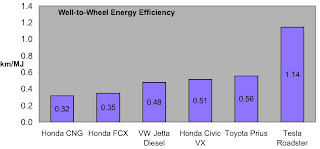 fessor Salmeen can easily be refuted by the Tesla Motors study. In the Tesla Motors study, electric cars are presented as far more efficient than gasoline cars. While Professor Salmeen's argument centers around mathematic estimates (as implied by his title), Tesla Motors provides concrete data from actual cars.
Also, the environmental benefits of electric cars were overlooked. We know the environmental detriments gasoline cars have on our society. Although it may be currently unclear whether electric cars are more efficient than gasoline cars, the fact remains that the end user can ultimately choose which type of electricity source to use to power their car. Imagine, powering your car with solar or wind energy!
Lastly, increased use of electric cars may change the composition of energy markets, but will energy prices really increase? Electric cars are becoming more efficient with new technologies. People are harnessing unused forms of energy (wind and solar). Taking these concepts into account one could argue that electric cars could lower energy prices in the future.
Although some of my points are based off of Tesla Motors, an electric car company, they present concrete numbers from concrete studies based on actual cars. I'm confident that with the increased popularity in electric cars, we will discover the answer to whether electric or gasoline cars are the way to go.
First off, the math performed by Pro
 fessor Salmeen can easily be refuted by the Tesla Motors study. In the Tesla Motors study, electric cars are presented as far more efficient than gasoline cars. While Professor Salmeen's argument centers around mathematic estimates (as implied by his title), Tesla Motors provides concrete data from actual cars.
Also, the environmental benefits of electric cars were overlooked. We know the environmental detriments gasoline cars have on our society. Although it may be currently unclear whether electric cars are more efficient than gasoline cars, the fact remains that the end user can ultimately choose which type of electricity source to use to power their car. Imagine, powering your car with solar or wind energy!
Lastly, increased use of electric cars may change the composition of energy markets, but will energy prices really increase? Electric cars are becoming more efficient with new technologies. People are harnessing unused forms of energy (wind and solar). Taking these concepts into account one could argue that electric cars could lower energy prices in the future.
Although some of my points are based off of Tesla Motors, an electric car company, they present concrete numbers from concrete studies based on actual cars. I'm confident that with the increased popularity in electric cars, we will discover the answer to whether electric or gasoline cars are the way to go.
Saturday, October 3, 2009
Electric Cars are NOT the Answer: Why Electricity Makes as Much Sense as Ethanol
First Tesla Motors, then the Chevy Volt. Yes, they're cool...but do they make sense?
The answer? A clear no. Below is an image from Irv Salmeen, a Prof. at the Univ. of Michigan.

And this, of course, does not take into account the (notable) increase in prices due to both global demand for the primary fuels for electricity generation and electricity itself.
The answer? A clear no. Below is an image from Irv Salmeen, a Prof. at the Univ. of Michigan.

And this, of course, does not take into account the (notable) increase in prices due to both global demand for the primary fuels for electricity generation and electricity itself.
Subscribe to:
Posts (Atom)


 Posts
Posts

